
AI, ML and Data Science Programme
Round Application Deadline
Upcoming deadline:Invalid liquid data | App fee - USD 50
What Is the AI, ML and Data Science Programme About?
The AI, ML and Data Science Programme by the NUS Computing is a globally recognised 8 month programme designed for Singapore working professionals who want to advance their careers with the skills to transform data into actionable business insights and build AI-powered solutions.
This is one of the few artificial intelligence and data science programmes that combines global academic rigour with Singapore and regional business context — accessible entirely online from Singapore or anywhere in APAC.
The programme emphasises real-world application through live masterclasses, hands-on exercises, capstone projects, and exposure to emerging tools and technologies, enabling participants to design, implement, and optimise AI-driven systems that enhance decision-making, automate workflows, and drive competitive advantage.
Key Highlights:
Delivered by NUS School of Computing.
100% online — no career break required.
Designed for working professionals.
Globally recognised credential.
Recorded lectures along with live sessions for maximum flexibility.
Core Pillars of the programme
This programme combines three key pillars:
Data Analytics – Data to Insights: Learn to process, clean, visualise and analyse data using tools such as Power BI, Power Pivot and Orange, building a strong foundation in descriptive statistics, database querying and data mining techniques.
Programming with Python: Gain hands-on expertise with NumPy, Pandas, Scikit-Learn, Keras, TensorFlow and more to manipulate, model and deploy data-driven solutions.
Machine Learning, AI & GenAI Applications: Explore supervised and unsupervised learning, neural networks, reinforcement learning, deep learning, recommendation systems, Machine Learning Operations and Generative AI with Hugging Face and OpenAI Playground to create scalable and intelligent solutions.
Key Industry Trends in AI, ML and Data Science
30.4%
32.08%
24.89%
What makes the AI, ML and Data Science Programme Stand Out?

No prior coding experience
Programme designed for professionals without prior coding experience

Premium school experience
Certificate from Asia’s Leading University

Flexible mode of delivery
300+ Pre-recorded video lectures* from NUS faculty for self-paced learning

Live and interactive sessions
5 live sessions with faculty

Comprehensive curriculum
30+ modules covering Data Analytics, Python, Machine Learning, Deep Learning and more

Networking immersion
1-day networking opportunity to meet with fellow global leaders and interact with programme faculty/director

Capstone project
Demonstrate your newly gained AI, ML and Data Science skills through a capstone project that applies learning from modules to real-world challenges

Distinguished faculty
Learn via video lectures from renowned faculty at NUS School of Computing

Topics on AI and Gen AI
AI and Gen AI topics covered through modules and faculty live sessions

Practical knowledge
Gain hands on learning through tools and weekly assignments
Note: The programme highlights mentioned above are subject to change based on faculty availability and the desired outcomes of the programme.
*This programme is primarily self-paced online with some live sessions conducted by programme faculty. The availability of post-session video recordings is at the discretion of the faculty members, and Emeritus or the institute cannot guarantee their availability. We have a curated panel of distinguished industry practitioners who will conduct weekly live doubt-clearing sessions.
**Assignments will be graded by industry practitioners who are available to support participants in their learning journey, and/or by the Emeritus grading team. The final number of quizzes, assignments, and discussions will be confirmed closer to the start of the programme.\
***Participants are responsible for arranging their own travel and accommodation for the on-campus networking sessions.
***All benefits are subject to change at the discretion of NUS School of Computing.
What Will You Learn in the AI, ML and Data Science Programme?
Data-Driven Decision-Making with Statistical and Analytical Techniques - Gain foundational knowledge in statistics and analytics to extract meaningful insights from raw data and support strategic business decisions.
Database Management and Modelling with DB Browser for SQLite, Power BI Desktop and Excel - Build, clean and manipulate data using industry-standard tools. Create relational databases, construct data models and prepare datasets for visualisation and analysis.
Python for Data Science: End-to-End Data Workflows - Use Python with core libraries like NumPy, Pandas and Scikit-Learn to automate data collection, cleaning, transformation, analysis and modeling for scalable solutions.
Applied Machine Learning: Algorithms and Use Cases - Implement supervised and unsupervised machine learning algorithms including classification, regression, clustering and association rule mining. Understand model evaluation and optimisation for real-world problems.
Deep Learning with TensorFlow and Keras - Design, train and optimise deep learning architectures such as neural networks and CNNs. Use TensorFlow and Keras to solve complex tasks like image recognition, sentiment analysis and more.
Operationalising AI: Machine Learning Operations and Model Lifecycle Management - Deploy and manage AI models at scale using Machine Learning Operations principles. Leverage tools like MLflow and version control to track experiments, manage reproducibility and streamline model updates and deployment.
Recommendation Engines and Reinforcement Learning - Build and evaluate recommendation systems using collaborative filtering, content-based filtering and hybrid approaches. Explore reinforcement learning to develop models that learn from dynamic environments and feedback loops.
Generative AI and Natural Language Processing (NLP) - Explore the power of generative AI and NLP with tools such as OpenAI Playground, Hugging Face and Transformer-based models. Apply these technologies to a wide range of language and AI applications.
Responsible AI - Explainability, Fairness and Governance - Ensure transparency, fairness and accountability in AI models. Apply responsible AI principles to enhance explainability, mitigate bias and uphold ethical standards in AI deployment.
Is the AI, ML and Data Science Programme right for You?
The programme is designed for professionals without prior coding experience, from both tech and non-tech domains, who want to:
Pivot into a Machine Learning career
Acquire Machine Learning concepts and techniques to transition into Machine Learning roles
Gain the expertise to lead and solve real-world business problems with data and modelling at the core
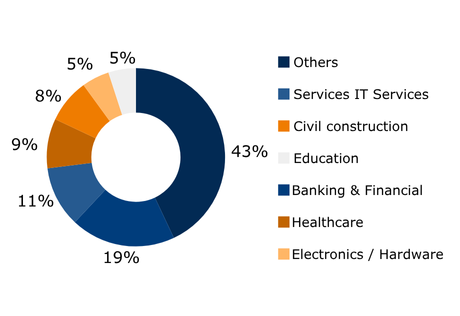
The programme is particularly applicable to major industries such as IT products and services, banking and financial services, consulting, education, healthcare and retail.
AI, ML and Data Science Programme Curriculum
Orientation - Course Overview
Orientation - Course Overview
Section 1 - Data Analytics - Data to Insights
Module 1 - Introduction to Analytics
The role of analytics in business intelligence and artificial intelligence
Data processing chain
A simple analytics example
Module 2 - Mathematics Fundamentals
Descriptive statistics & data distributions
Different datatypes attributes
Percentages, ratios & growth metrics
Understanding relationships: correlation & causation
Basic probability concepts
Module 3 - Database: Data Source and Data Queries
Understanding databases structure
Exploring a database in SQLite
Getting started with queries using SQLite
Turning data into information
Working with multiple tables
Using functions
Module 4 - Data Warehouse: Load and Transform Data and Create a Data Model
Data preparation and data wrangling
Introduction to Exploratory Data Analysis (EDA)
Exploring and importing data into Power Pivot
Data munging with Power Query
Star schema data model
Creating a data model in Power Pivot
Module 5 - Data Visualisation: Pivot Tables and Charts and Power BI Basics
Working with Pivot tables and charts to create visualisations
Creating the BI interface in Excel
Case study using Power Pivot: Reseller Sales Analysis
Creating data Model, visualisations and dashboards in Power BI
Case study using Power BI: Sales Quota Analysis
Common visualisations used in EDA
Module 6 - Data Mining Basics
The fundamentals of data mining and CRISP-DM
Demonstrating unsupervised learning technique, specifically, K-Means clustering in Orange using practical examples
Demonstrating supervised learning techniques such as decision tree and linear regression models in Orange to solve real-life problems
Online Live Session by Faculty: Masterclass - AI in Data Analytics
Section 2 - Programming with Python
Module 7 - Getting Started with Python
Introduction to Python as a programming language
Identifying types of errors in a Python program
Examining the basic building blocks in a Python program
Creating a simple Python program
Module 8 - Collections, Strings and Comments
Using appropriate containers or collection data types to store data
Applying properties of lists, tuples, sets and dictionaries to organise data
Manipulating data and containers using functions and built-in methods on collections
Identifying the characteristics of strings
Implementing functions, operators and built-in methods on strings
Module 9 - Operators and Program Flow Controls
Explaining concept of various operators
Using operators under appropriate conditions
Applying operator precedence and associativity for expression resolution
Examining the different types of program flow control
Utilising appropriate program flow control mechanisms
Executing sequence, selection and iteration program flow controls
Module 10 - Functions, Import Statements, Inputs, Outputs, Exception Handling and File Handling
Exploring different types of functions
Differentiating functions from methods
Applying import keywords to Python modules
Applying the correct input syntax
Using exception statements to handle code errors
Displaying outputs with the correct syntax and format
Exploring methods in handling text and binary files
Module 11 - The Numpy Library
Applying concepts in indexing, slicing and iterating arrays
Understanding the process of reading and writing arrays into files
Exploring the methods to manipulate arrays
Module 12 - The Pandas Library
Creating and manipulating series and dataframes in the pandas library
Applying operations and functions to manipulate and manage values
Module 13 - Scikit Learn and Keras
Overview on Scikit learn
Classification, regression, clustering, model selection, pre-processing and dimensionality reduction in Scikit Learn
Importing the library along with various functions required for model evaluation- confusion matrix, test_train_split etc.
Overview on deep learning
Types of models supported by Keras
Importing the library and building models in Keras and its applications
Module 14 - Data Visualisation
Creating data visualisations in matplotlib, pandas plot and Seaborn library
Applying concepts in enhancing and manipulating data visualisations
Module 15. Python Application Development
Applying concepts in Python to create an Inventory Management System
Building a Python application using external data
Online Live Session by Faculty: The application of concepts learned, doubt clarification, summary of overall section
Section 3 - Machine Learning and AI Applications
Module 16 - Introduction to Machine Learning and Artificial Intelligence
Defining artificial intelligence, machine learning and data science and their correlation
The history and applications of AI and machine learning
Future trends and approaches in the AI field
Learning patterns of machines
The machine learning process and approaches
Concepts of learning difficulties and lack of performance
Underfitting and overfitting
Module 17 - Supervised Learning: Classification
Applications of classification in business scenario
Explanation of dependent variable in classification
Continuous dependent variable versus categorical variable
Machine Learning techniques to predict the classes in classification
Demonstration using logistic regression in Python
Discussion of model statistics to evaluate the model
Module 18 - Supervised Learning: Regression
Regressive algorithms for implementing supervised learning with examples
Case study discussion: The use of supervised learning, specifically linear regression in NBA teams to improve their ranking and win a cup
Regressive models such as function estimation as linear regression and classification using logistic regression
The role of regressive models in function estimation and classification
Module 19 - Supervised Learning: Decision Trees
The theory, terminologies and applications of decision trees
The random forest ensemble system for high-performance decision-making and its applications
Machine learning concepts such as the entropy, GINI index and imbalanced classes issues
Module 20 - Support Vector Machine Algorithms
Defining support vector machine (SVM) and explaining the underlying algorithm
Discussing parameter tuning in SVM
Demonstrating SVM for classification and regression
Advantages and disadvantages of using SVM
Module 21 - Unsupervised Learning: Clustering techniques in K-Means
Describing the K-means clustering algorithm
Developing and using the K-means algorithm using Scikit Learn
Optimising a clustering system by changing the clustering parameters
Visualising the results of clustering
Module 22 - Unsupervised Learning: Hierarchical Clustering Method
Different applications of hierarchical clustering
The importance of metrics and linkage criteria in hierarchical clustering
Top-down and bottom-up approaches of hierarchical clustering
The implementation of hierarchical clustering and interpretation of results
Module 23 - Unsupervised Learning: Probabilistic and Association Rule
Overview of probabilistic clustering and comparison with K-means
Exploring the Gaussian Mixture Model and Expectation Maximisation algorithm
Overview of association rule and its application
Applying pre-processing and Apriori algorithm
Demonstration of association rule for market basket analysis
Module 24 - Neural Network
The theory, terminology and definition of artificial neural networks
Training algorithms of neural networks
Neural network parameters and ways to prevent underfitting and overfitting
Identifying a multi-layer perceptron as a solution to the problems of nonlinearity
The implementation of some machine learning applications in the system
Developing a model of biological brain as an artificial neural network
Examples of how to use neural networks as a function estimator
Setting optimal parameters to improve performance
Module 25 - Reinforcement Learning
Definitions and applications of reinforcement learning
Types of reinforcement learning
Reinforcement learning examples, such as traffic light control and personalised recommendation systems
Robot navigation using reinforcement learning
Module 26 - Deep Learning Using Keras and Tensorflow
Defining deep learning and its applications
Examining how deep neural networks deal with semi-structured and unstructured data
Explain types of networks and its applications
Exploring backward and reverse propagation
Describing layers in sequential neural net-hidden layers, input and output layers
Describing hyperparameters in neural net
Demonstration and application of deep learning techniques
Module 27 - Deep Learning: Advanced Topics
Model compression & quantisation techniques
Advanced Deep Convolutional Models
Introduction to GANs (Generative Adversarial Networks)
Self-supervised learning techniques
MLflow for experiment tracking and model lifecycle management
Module 28 - Recommendation Systems
Defining recommendation systems and its uses
Exploring types of recommendation systems and their advantages and disadvantages
Module 29 - MLOps and Model Deployment
Model monitoring and logging in production
Deploying reinforcement learning models in real-world environments
Version control for machine learning models
Automated model retraining pipelines
Scaling deep learning models for production
Deploying recommendation systems at scale
A/B testing and monitoring recommendation models
Online Live Session by Faculty: Deep learning and recommended system applications and tools
Module 30 - Gen AI and Prompt Engineering
Introduction to Generative AI
Understanding LLMs (Large Language Models) and their architecture, Agentic AI
Prompt Engineering: Crafting effective AI prompts
Hands-on with OpenAI Playground/APIs
Online Live Session by Faculty: Suggested topic - Agentic AI UseCases
Module 31 - Natural Language Processing
Introduction to NLP and Hugging Face
Text preprocessing, tokenisation, and word embeddings
Named Entity Recognition (NER), Sentiment Analysis
Fine-tuning pre-trained models for NLP tasks
Hands-on with Transformers and pre-trained LLMs (BERT, GPT-3)
Module 32 - Advanced AI & Future Trends in AI
AI-powered AutoML & Neural Architecture Search (NAS)
Hands-on with state-of-the-art models in 2025
Ethical concerns & AI governance frameworks
Explainable AI (XAI) techniques: SHAP, LIME, and model interpretability
Understanding Bias & Fairness in ML Models
Online Live Session by Faculty: Suggested topic - Future of AI: Quantum & Responsible AI
Learn Live: Faculty-Led Sessions on AI, ML and Data Science
AI in Data Analytics

Programming with Python: Applications, Summary and Doubt Solving
Agentic AI UseCases
Future of AI: Quantum & Responsible AI
Deep Learning and Recommended System Applications and Tools
Note - Topics are subject to change depending of faculty expertise and availability.
AI, ML & Data Science Case Studies: Bridging Theory and Practice

Marketing Analysis for a Sunglasses Retailer
In this case study, the faculty demonstrates how to use data to provide insights on the potential customers of a sunglasses retailer.

Airlines Delay Data Analyis
In this demonstration, the faculty shows how to transform data on flight delays into a user-friendly interface.

Performance Analysis of Top 10 Tennis Players
In this case study, the faculty demonstrates the application of logical flow in programming using various statements in Python to the study the performance of athletes.

Movie Reviews Analysis
In this case study, the faculty demonstrates several operations on string data to organise and display audience feedback.

Hierarchical Clustering for a Data Set on Celebrities
Through a lecture video, the faculty will show how to develop a system to cluster a dataset containing information on celebrities.

Boston Housing Dataset Analysis
In this demonstration, the faculty demonstrates the application of neural network concepts to identify the median value of houses in Boston based on input features.
What In-Demand Tools Are Covered in the AI, ML and Data Science Programme?








Note:
All product and company names mentioned in this material are trademarks or registered trademarks of their respective holders. Their use does not imply any affiliation with or endorsement by them.
The tools will be taught by teaching faculty, industry practitioners, or linked to relevant knowledge bases for your reference and self-guided learning.
Apart from the tools mentioned above, learners will get to experience other industry related tools.
The Faculty Behind the AI, ML and Data Science Programme

DANNY POO
Associate Professor
Dr Danny Poo is a tenured Associate Professor at School of Computing (SOC), National University of Singapore (NUS).
Dr. Poo is a member of the School’s Curriculum Committee t...

AMIRHASSAN MONAJEMI
Senior Lecturer (Educator Track)
Dr Amirhassan Monajemi is a Senior Lecturer with the School of Computing, National University of Singapore (NUS).
Before joining the NUS, he was with the Faculty of Computer ...
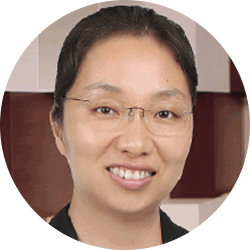
AI XIN
Lecturer (Educator Track)
Dr. Ai Xin is currently a Lecturer with the School of Computing at the National University of Singapore (NUS).
She has many years of experience teaching Artificial Intelligen...
Past Participant Profiles
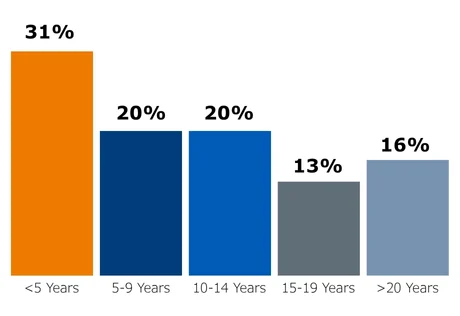
Work Experience
Industries
What learners have to say about the AI, ML and Data Science Programme
The NUS School of Computing Advantage
#1
#8
#2
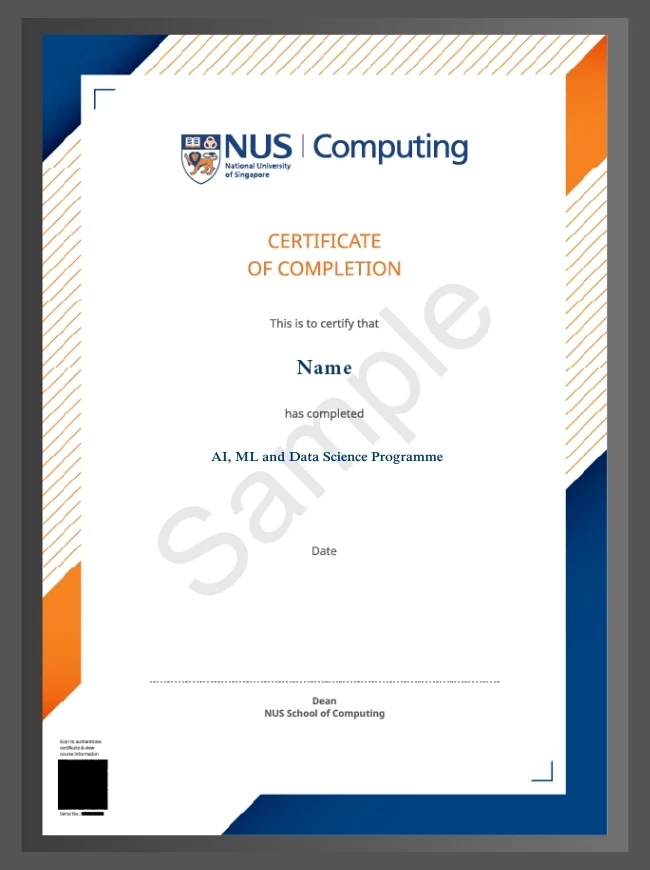
Certificate Awarded on Completion of the AI, ML and Data Science Programme
Upon successful completion of the AI, ML and Data Science programme, participants will be awarded a verified digital certificate by NUS School of Computing.
Emeritus Career Services
Stepping into a business leadership career requires a variety of job-ready skills. Below given services are provided by Emeritus, our learning collaborator for this program. The primary goal is to give you the skills needed to succeed in your career; however, job placement is not guaranteed.
Emeritus provides the following career preparation services:
Resume building videos
Interview preparation videos
Linkedln profile building videos
Glossary of resume templates
Please note:
NUS or Emeritus do not promise or guarantee a job or progression in your current job. Career Services is only offered as a service that empowers you to manage your career proactively. The Career Services mentioned here are offered by Emeritus. NUS is not involved in any way and makes no commitments regarding the Career Services mentioned here
The Learning Experience
What is it like to learn with the learning collaborator, Emeritus?
More than 300,000 professionals globally, across 200 countries, have chosen to advance their skills with Emeritus and its educational learning partners. In fact, 90 percent of the respondents of a recent survey across all our programs said that their learning outcomes were met or exceeded. All the contents of the course would be made available to students at the commencement of the course. However, to ensure the program delivers the desired learning outcomes, the students may appoint Emeritus to manage the delivery of the program in a cohort-based manner during the course period the cost of which is already included in the overall Course fee of the course.
A dedicated program support team is available 7 days a week to answer questions about the learning platform, technical issues, or anything else that may affect your learning experience.
Frequently Asked Questions about the AI, ML and Data Science Programme
Who should enrol for the AI, ML and Data Science programme?
The programme is designed for professionals without prior coding experience*, from both tech and non-tech domains, who want to pivot into a Machine Learning career and acquire Machine Learning concepts and techniques to transition into Machine Learning roles. Gain the expertise to lead and solve real-world business problems with data and modelling at the core, empowering you to make impactful decisions and drive innovation across industries. The programme is particularly applicable to major industries such as IT Product & Services, Banking and Financial Services, Consulting, Education, Healthcare, and Retail, across sectors and functions. Although no prior coding experience is required, non-tech participants are encouraged to put additional effort and complete the set of pre-readings provided to prepare for the course.
What topics are covered in the curriculum of AI, ML and Data Science programme?
The curriculum covers topics such as python, machine learning, data analytics, python programming, python for data analytics, python for machine learning, amongst others.
What hands-on learning experience I will gain in the AI, ML and Data Science Programme?
You will work with tools like SQLite, PowerPivot, Orange Data Mining and more. Complete a capstone project applying AI with deep learning techniques to solve industry challenges.
How are classes conducted for the AI, ML and Data Science Programme?
The programme is delivered online with live sessions from NUS School of Computing faculty and industry experts. Pre-recorded videos allow flexible learning, while live sessions enable real-time interaction.
What is the weekly time commitment for the AI, ML and Data Science Programme?
Expect 6–8 hours weekly over 8 months, including video lectures, assignments, and live discussions.
Are there flexible payment options available?
Yes, the programme offers flexible payment options. You can choose to pay the full fee upfront or spread the cost over two or three instalments, making it easier to manage your finances.
Are there any networking opportunities during the AI, ML and Data Science Programme?
Yes, there's a 1-day campus immersion (optional) for networking with peers and faculty members.
Do all participants get certificate of completion?
Upon successful completion of the programme, participants will be awarded a verified digital certificate by NUS School of Computing.
How long will I retain the access to learning materials?
Access the platform and resources for 12 months post-programme to revisit the content and stay updated.
What skills will I gain from the AI, ML and Data Science programme by NUS Computing?
You will learn data analytics, Python programming, machine learning, deep learning, Generative AI, MLOps, data visualisation, and model deployment skills through practical applications and projects.
Is this programme suitable for non-technical professionals in Singapore?
Yes. The programme is designed for professionals without prior coding experience and provides foundational as well as advanced AI and data science training.
What programming tools and technologies are covered in this programme?
The programme includes tools such as Python, NumPy, Pandas, Scikit-Learn, TensorFlow, Keras, Power BI, Orange, Hugging Face, and OpenAI Playground/APIs.
How does this programme help in transitioning to data science roles?
The AI, ML and Data Science programme builds practical, job-ready skills through hands-on exercises, real-world AI applications, and industry-relevant projects that prepare learners for data science and AI-driven roles.
What is the duration and weekly time commitment?
The programme offers flexible, self-paced learning with 300+ pre-recorded lectures and live faculty sessions, making it suitable for working professionals.
Does the programme include hands-on projects or a capstone project?
Yes. Participants complete hands-on exercises and a capstone project that applies AI, ML, and data science concepts to real-world business challenges.
How is this programme delivered for working professionals?
The programme is delivered online through self-paced video lectures, live interactive faculty sessions, and networking opportunities, allowing flexibility for busy professionals.
What career opportunities can I explore after completing this programme?
Graduates can explore roles in data analytics, machine learning, AI development, business intelligence, data-driven decision-making, and AI-powered digital transformation across industries
How does this programme help in building real-world AI and data skills?
The curriculum emphasises practical learning through live masterclasses, applied machine learning exercises, deep learning projects, recommendation systems, MLOps, and Generative AI applications.
Early registrations are encouraged. Seats fill up quickly!
Starts On