

Full Stack Development with AI
Accelerate your full stack development career with AI integration
- Certification from Asia’s #1 ranked institute (QS World University Ranking 2024)
- Learn integration of AI and Gen AI in full stack development cycle
- Online with 2+ live sessions
- 2-week capstone project
Round Application Deadline
Upcoming deadline: Invalid liquid data
What is the NUS Full Stack Development with AI Programme About?
13%
#1
21%
A Glimpse into Your Full Stack Development with AI Learning Journey
How the Full Stack Development with AI Programme Stands Out?

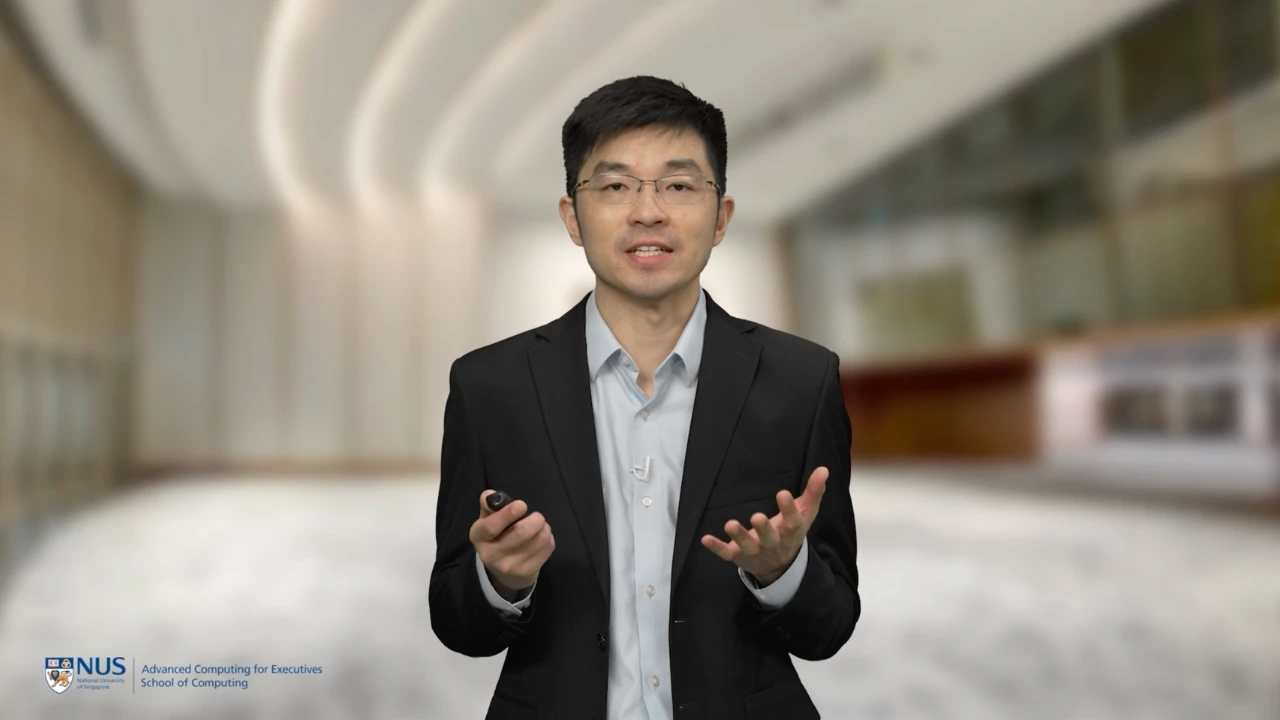
Pre-recorded video lectures* from NUS faculty for self-paced learning

Earn a certificate from Asia’s highest-ranking institute

Modules on AI and Generative AI to understand the application of AI in full stack development cycle

2+ live sessions with faculty and industry experts

2-week capstone project to apply the learnings in real-world scenario

Learn tools used across Singapore’s tech industry

Application-based assessment to enhance critical thinking
Note:
This is a self-paced asynchronous programme. Post-session video recordings will be available for up to 12 months after programme completion.
Assignments are graded by industry practitioners who are available to support participants in their learning journey and/or by the Emeritus grading team.
The final number of quizzes, assignments and discussions will be confirmed closer to the programme’s start date.
What Skills Will You Gain from the Full Stack Development with AI Programme?
Gain skills and knowledge for proficient development of end-to-end applications.
Master both frontend and backend technologies through an immersive learning experience.
Gain an understanding of AI fundamentals and their integration into full-stack development.
Identify areas where AI can create value, improve efficiency, optimise processes, and enhance decision-making within organisations.
The NUS School of Computing Advantage
#1
#8
#2
Who Should Enrol in NUS School of Computing's Full Stack Development with AI Programme?
This Full Stack Development with AI programme is designed for:
Entry level tech professionals looking to start a career or switch to a high-growth field and gain exposure to the full development lifecycle.
Early and mid-level tech professionals looking for new trends and technologies to bring innovation and automation to their organisations.
Note: Prior coding experience, including professional coding and/or self-taught coding and/or beginner-level coding will be helpful. Learners with no tech background, may have to put additional efforts.
Full Stack Development with AI Programme Curriculum
Phase 1: Introduction
Module 1: Fundamentals for Beginners
Introduction to Programming
Working with Variables and Operators
Working with Control Flows
Working with Functions
Overview of Web Development Technologies
Introduction to Full Stack Development
Phase 2: Web Development
Module 2: Introduction to Git
Introduction to Git and GitHub
Tracking Changes to a Git Repository
Working with a Remote Repository in GitHub
Basic Branching and Merging Operations
Merge Conflict Resolution
Module 3: HTML and CSS Fundamentals
Structure & Syntax of HTML pages
Common HTML tags
Working with URLs
Working with Form-Related Tags
Introduction to CSS
Introduction to Document Object Model (DOM)
Basic CSS Selectors
Common CSS Properties
Module 4: Intermediate HTML and CSS
Semantic HTML5 Elements
Advanced CSS Selectors
Generating Basic Layout using CSS
CSS Flexbox
CSS Grid
Introduction to Responsive Design
Introduction to Frontend Design Frameworks
Generate Responsive Layout using CSS Frameworks
Working with Templates
Module 5: Introduction to JavaScript
Introduction to JavaScript
Variables, Data Types, and Operators in JavaScript
Conditional Control Flow with JavaScript
Iterative Control Flow with JavaScript
JavaScript Functions
Arrays and Objects in JavaScript
DOM Programming Interface for HTML
Basic DOM Manipulation with JavaScript
Module 6: Introduction to Python
Variables, Data Types, and Operators in Python
Basic Input and Output with Python
Conditional Control Flow with Python
Iterative Control Flow with Python
Python Functions
Basic Data Structures in Python
Limitations of Python Basic Data Structures
Overview of Python Libraries for Data Science and AI
Data Processing with NumPy ndarray
Introduction to Pandas Series
Introduction to Pandas DataFrame
Data Preparation with Pandas DataFrame
Data Visualisation with Matplotlib
Phase 3: Frontend Development
Module 7: Frontend frameworks
Introduction to Frontend Frameworks
Traditional Approach to Frontend Development
Modern Approach to Frontend Development
Declarative Approach to Development
Component-Based Design
Single Page Applications
Getting Started with Frontend Development Frameworks
Module 8: Working with React
Introduction to React
Setting Up a React Webpage
JSX and Transpiling
Working with Props in React
JavaScript Expressions in React
ES6 Constructs in React Applications
ES6 Module System and Organising React Applications
Creating React Applications without Setup
Handling HTML and React Events
Difference Between Props and States
React Hooks and State Variables
Controlled vs Uncontrolled React Components
AJAX and the fetch() API
Working with the useEffect Hook
Working with the useRef Hook and React Hooks Rules
Using React Router for Multiple Pages
Creating and Organising React Applications with Create React App
Phase 4: Backend Development and Databases
Module 9: Relational Databases and SQL
Introduction to Database Systems
Database Modeling and Data Models
The Relational Database Model
Create an Entity Relationship (ER) Diagram
Basics of Structured Query Language (SQL)
Write SQL Data Manipulation Language (DML)
Write Advanced SELECT Queries
Write SQL Joins to Combine Data from Multiple Tables
Module 10: Introduction to Backend Development
Overview of Backend Software Engineering with JavaScript and Python
Introduction to Node.js and Express.js
Server-side Web Application Development with Express.js
Using the Pug Template Engine with Express.js
Creating Database-driven Web Application with Express.js
Introduction to Flask
Server-side Web Application Development with Flask
Using the Jinja2 Template Engine with Flask
Creating Database-driven Web Application with Flask
Module 11: Non-relational Databases and MongoDB
Introduction to NoSQL Databases
Basics of Document-based Databases
Set up MongoDB Environment for NoSQL Database
Insert and Find Documents
Query Documents and Query Operators
Query Arrays and Nested Documents
Update and Delete Documents
Connecting to MongoDB Driver for Applications
Module 12: RESTful API Development
Overview of Service-Oriented Architecture (SOA) and Microservices Architecture
Introduction to RESTful Web Services
Introduction to JSON
Best Practices in RESTful API Design
Creating RESTful API Endpoints with Express.js
Testing RESTful API Endpoints with Postman
Creating RESTful API Endpoints with Flask and Connexion
Phase 5: AI Fundamentals
Module 13: Introduction to Artificial Intelligence and Machine Learning
Overview of AI and its Subfields
Supervised, Unsupervised, and Reinforcement Learning Revisited
Overview of Python Libraries: Sklearn, Tensorflow, PyTorch, and Keras.
Real-world Applications of AI and Machine Learning
Module 14: Introduction to ANN
Basics of Artificial Neuron and Activation Functions
Perceptron
Multi-layer Neural Networks
Basics on Training Neural Networks with Gradient Descent
Phase 6: Integrating AI Into Full Stack Applications
Module 15: Introduction to Deep Learning
Introduction to Deep Learning
Convolutional Neural Networks (CNNs) for Image Data with Keras Example
Recurrent Neural Networks (RNNs) for Text Data with Keras Example
Module 16: Integrating AI Models into Full Stack Applications
Overview of Model Persistence and Serving
Saving and Loading scikit-learn Models
Saving and Loading Keras Models
Serving Models via RESTful API Endpoints Using Python with Flask and Connexion
Consuming RESTful API Endpoints from a React Web Application Using axios
Consuming RESTful API Endpoints from an Express.js Backend Using axios
Consuming RESTful API Endpoints from a Flask Backend Using Requests
Serving a Model using MLflow
Module 17: Introduction to AI-Driven Features
Introduction to Recommendation Systems
Preliminary Mathematical Considerations of Recommendation Systems
Content-Based Recommender System
Building Content-Based Recommender System
Collaborative Filtering Recommender System
Introduction to Model-based Collaborative Filtering Recommender System
Model-based Collaborative Filtering Recommender System
Recommendation using Softmax Model
Module 18: Performance Optimisation and Scalability
Introduction to Performance Optimisation and Scalability
Optimising AI Model Performance
Scaling Strategies and Database Optimisation
Caching and Load Balancing
Asynchronous Processing and Message Queues
Monitoring and Performance Analysis
Load Testing Fundamentals and Analysis
Best Practices and Future Trends
Module 19: Generative AI application
Introduction to Generative AI in Full Stack Development
Benefits and Use Cases of Generative AI in Full Stack Applications
Advanced Generative AI Applications
Generative AI in Software Development
Evolution of Language Models: From Traditional to Transformers
Milestones in Large Language Models
Optimising LLM Outputs: Prompts and Parameters
Fine-tuning LLMs
Introduction to LLM Selection and AI Agents
LLM Performance and Benchmarks
Evaluating LLM Requirements for Specific Use Cases
LLM Deployment Considerations
Combining Multiple LLMs for Complex Applications
Introduction to AI-Powered Software Development
Features of Autonomous AI Software Engineers
Pros and Cons of Autonomous AI Agents in Software Development
What In-Demand Tools will you learn in the Full Stack Development with AI Programme?











Note:
All product and company names mentioned in this material are trademarks or registered trademarks of their respective holders. Their use does not imply any affiliation with or endorsement by them.
The tools will be taught by teaching faculty, industry practitioners, or linked to relevant knowledge bases for your reference and self-guided learning.
Apart from the tools mentioned above, learners will get to experience other industry related tools.
The Faculty Behind the Full Stack Development with AI Programme

Prof. Tan Wee Kek
Associate Professor (Department of Information Systems & Analytics)
Prof. Tan Wee Kek graduated with a Doctor of Philosophy in Information Systems in July 2013 and a Bachelor of Computing in Information Systems (1st Class Honours) in July 2007...

Dr. Lek Hsiang Hui
Senior Lecturer (Department of Information Systems & Analytics)
Lek Hsiang Hui is a Senior Lecturer at the Department of Information Systems and Analytics at the National University of Singapore (NUS) School of Computing. He graduated with...

Dr. Prabhu Natarajan
Senior Lecturer (Department of Computer Science)
Dr. Prabhu Natarajan is a Senior Lecturer at the National University of Singapore's School of Computing. With over a decade of teaching experience, Dr. Natarajan has instructe...

Ms. Samantha Sow
Senior Lecturer (Department of Information Systems & Analytics)
Ms. Samantha Sow is currently a Senior Lecturer in the department of Information Systems and Analytics at the National University of Singapore (NUS). She has over 8+ years of ...

Mr Uli Hitzel
Industry Expert (Dyson)/Executive Education Fellow (Date Engineering & Automation)
Uli Hitzel has been working with data engineering, automation, and distributed systems since the early days of the internet. With experience from companies including Dyson, Mi...
What Learners Have to Say About the Full Stack Development with AI Programme?
What Certificate Will You Receive?
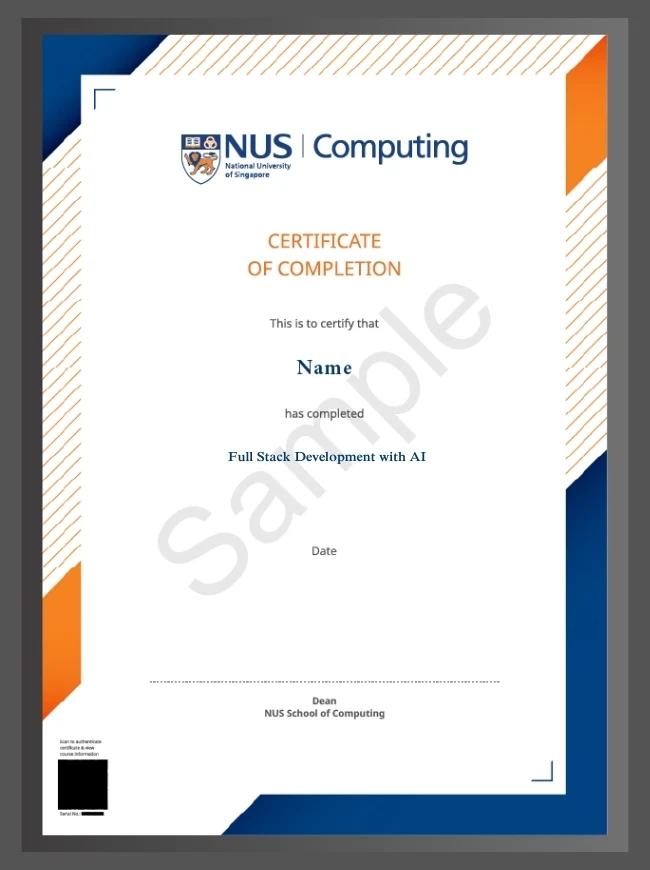
Participants who successfully complete the Full Stack Development with AI programme will receive a verified digital certificate by the NUS School of Computing.
Note:
All certificate images are for illustrative purposes only and may be subject to change at the discretion of the NUS School of Computing.
Emeritus Career Services
Stepping into a business leadership career requires a variety of job-ready skills. Below given services are provided by Emeritus, our learning collaborator for this program. The primary goal is to give you the skills needed to succeed in your career; however, job placement is not guaranteed.
Emeritus provides the following career preparation services:
Resume building videos
Interview preparation videos
Linkedln profile building videos
Glossary of resume templates
Please note:
NUS or Emeritus do not promise or guarantee a job or progression in your current job. Career Services is only offered as a service that empowers you to manage your career proactively. The Career Services mentioned here are offered by Emeritus. NUS is not involved in any way and makes no commitments regarding the Career Services mentioned here
Frequently Asked Questions About the Full Stack Development with AI Programme
Who should enrol for the Full Stack Development with AI Programme?
The full stack development with AI is an NUS SOC online programme designed for entry level tech professionals looking to start a career or switch to a high-growth field and gain exposure to the full development lifecycle. It is also suited for early and mid-level tech professionals looking for new trends and technologies to bring innovation and automation to their organisations. Note: Prior coding experience, including professional coding and/or self-taught coding and/or beginner-level coding will be helpful. Learners with no tech background, may have to put additional efforts.
What topics are covered in curriculum of the Full Stack Development with AI Programme?
The curriculum of NUS Full Stack Development course covers topics such as full stack development with AI, web development, app development, frontend and backend technologies, and more. It also offers modules on AI and Generative AI to understand the application of AI in full stack web development cycle
What hands-on learning experience will I gain in the Full Stack Development with AI Programme?
You will gain hands on experience by working with tools like Pytorch, GitHub, Python+colab, ProGit, MySQL, and more. The programme also includes real-world case studies and a 2-week capstone project.
How are classes conducted for the Full Stack Development with AI Programme?
The Full Stack Development with AI programme is delivered online with live sessions from NUS School of Computing faculty and industry experts. Pre-recorded videos allow flexible learning, while live sessions enable real-time interaction.
What is the weekly time commitment for the Full Stack Development with AI Programme?
You should expect 6-8 hours of weekly commitment over 24 weeks, including video lectures, assignments, and live discussions.
Are there flexible payment options available?
Yes, the Full Stack Development with AI programme offers flexible payment options. You can choose to pay the full fee upfront or spread the cost over two or three instalments, making it easier to manage your finances.
Do all participants get certificate of completion?
Upon successful completion of the Full Stack Development with AI programme, participants will be awarded a verified digital certificate by NUS School of Computing.
How long will I retain the access to learning materials?
Access the platform and resources for 12 months post-programme to revisit the content and stay updated.
Is this full stack development course suitable for beginners or non-coders?
Yes. The programme starts with foundational web development concepts and gradually progresses to advanced full stack and AI integration topics, making it suitable for beginners and aspiring developers.
What programming languages and AI tools are covered in this programme?
The programme covers HTML, CSS, JavaScript, React, Node.js, Python, MySQL, MongoDB, TensorFlow, PyTorch, Keras, scikit-learn, Git, GitHub, and Google Colab.
How does AI integration enhance full stack development skills?
Learners gain the ability to build intelligent applications by integrating AI features such as chatbots, recommendation systems, predictive analytics, and smart search functionalities into full stack applications.
What projects or portfolio work will I build during the course?
Participants work on hands-on assignments and a capstone project that combines front-end, back-end, database, and AI components into a complete application portfolio piece.
What is the duration and flexibility for working professionals?
The programme runs for 24 weeks in an online format with flexible learning components designed for working professionals.
Does this course cover job-ready skills for the Singapore tech market?
Yes. The curriculum focuses on industry-relevant tools, collaborative development practices, deployment workflows, and AI-powered application development aligned with current technology demands.
How does this programme compare to traditional coding bootcamps?
Unlike many short-term bootcamps, this programme combines full stack development with AI integration, hands-on projects, and comprehensive end-to-end application development skills.
Early registrations are encouraged. Seats fill up quickly!
Starts On